
Size Data Center Power and Gas Supply on a Texas Tract
Barrio Grid is a Texas siting map that turns a tract into a power plan. Start from the power available, a gas supply, an IT target, or the most the land holds, and see the tie, the gensets and the flags.
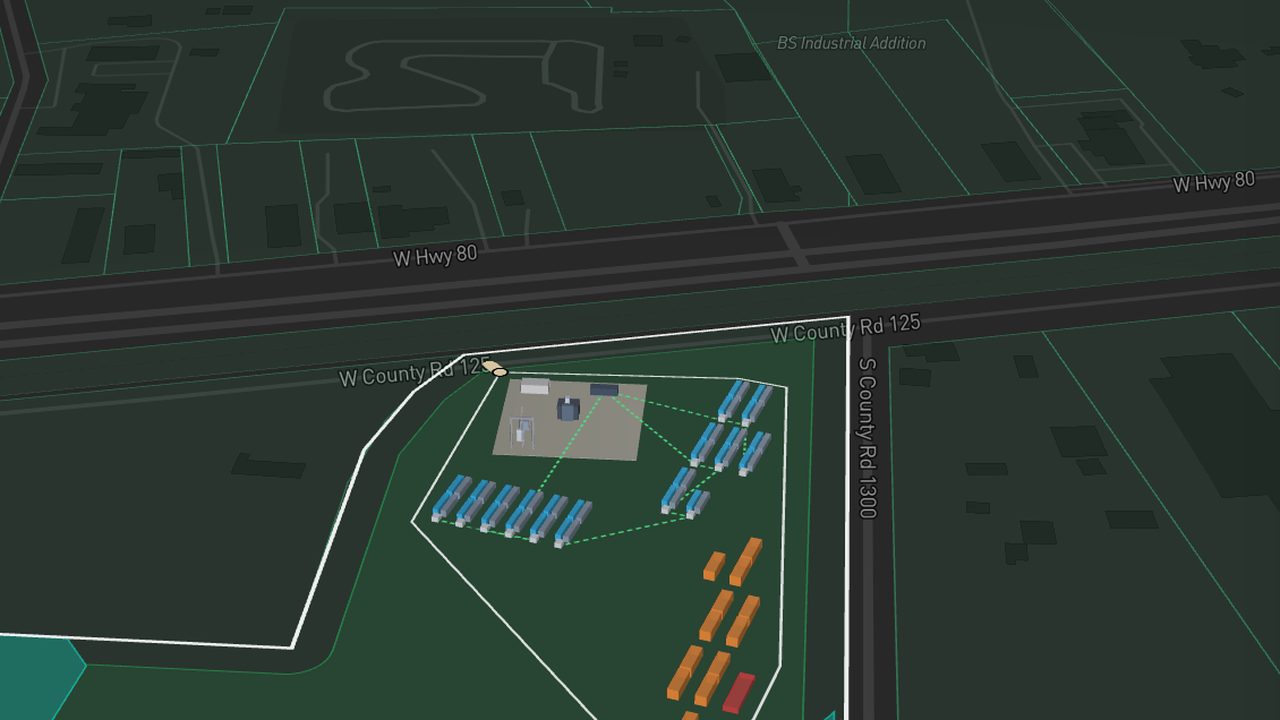
Sizing a data center from the power available
Power is the default way to size. Enter the MW available at the site, and the plan applies a PUE of 1.18 and builds from modular 1 MW IT containers (40 ft, DUG Nomad 40 spec). The tie is picked by size: one feeder under 10 MW, two feeders to 20 MW, a 138 kV load substation above that.
| Power available | IT load | Utility load | Tie |
|---|---|---|---|
| 10 MW | 8 MW | 9.4 MW | one distribution feeder |
| 30 MW | 25 MW | 29.5 MW | 138 kV load substation |
| 50 MW | 42 MW | 49.6 MW | 138 kV load substation |
| 100 MW | 62 MW | 73.2 MW | 138 kV, phase 1 cap of 74 MW |
Test runs on a 42 acre tract at PUE 1.18 with 1 MW containers. When the tract holds less than the power allows, the plan says so and re-picks the tie for what fits.
Data center gas supply in Texas: MMcf/d to MW
Convert the pipeline volume to MMBtu per hour, take a 10 percent margin, then divide by the genset heat rate. A 3 MMcf/d supply is 127.3 MMBtu/h, 114.5 MMBtu/h is usable after the margin, and at a heat rate of 8,465 Btu/kWh HHV it carries 13.5 MW, which is 11 MW of IT load.
| Supply as the pipeline quotes it | 3 MMcf/d |
| Energy, HHV | 127.3 MMBtu/h |
| Usable after a 10 percent margin | 114.5 MMBtu/h |
| Heat rate at the loading the sets run (recips, HHV) | 8,465 Btu/kWh |
| Generation it carries | 13.5 MW |
| IT load at PUE 1.18 | 11 MW |
| What 20 MW of IT needs | 199.1 MMBtu/h, 5.22 MMcf/d with margin |
The basis is EIA Texas heat content of 1,018 Btu/scf (2024) and Cat G3520H heat rates of 7,583, 7,728 and 8,073 Btu/kWh LHV at 100, 75 and 50 percent load, multiplied by 1.108 to get HHV. Ask the pipeline whether service is firm or interruptible, what the hourly limit is, what pressure is delivered at the tap, and what the gas quality spec is. Gas prime power needs a line 8 in or larger up to 20 MW utility load, and 12 in or larger above that.
Fuel cells vs turbines vs recip engines for data centers
The same 3 MMcf/d supports different loads depending on the machine. Here is what it carries by technology, using HHV heat rates, with units running plus a spare.
| Technology on 3 MMcf/d | Units | Btu/kWh HHV | Carries | IT | Fuel pressure |
|---|---|---|---|---|---|
| Recip engines (Cat G3520H, 2.5 MW) | 6+1 | 8,465 | 13.5 MW | 11 MW | low pressure, about 1.5 to 5 psig at the engine (10.2 to 34.5 kPa) |
| Industrial turbine (Solar Titan 130, 15 MW) | 1+1 | 10,742 | 10.7 MW | 9 MW | higher than recips; confirm the Titan 130 fuel gas pressure with Solar Turbines |
| Aeroderivative (GE LM2500XPRESS, 34.5 MW) | 1+1 | 9,605 | 11.9 MW | 10 MW | high: aeroderivatives can need inlet gas above 900 psig, so plan a fuel gas booster compressor unless the line runs that high |
| Aeroderivative (GE LM6000PF+, 53 MW) | 1+1 | 9,164 | 12.5 MW | 10 MW | high: aeroderivatives can need inlet gas above 900 psig, so plan a fuel gas booster compressor unless the line runs that high |
| Fuel cells (Bloom Energy Server, 325 kW) | 50+1 | 7,127 | 16.1 MW | 13 MW | 12 to 18 psig (15 nominal) |
- Recip engines (Cat G3520H, 2.5 MW) carry 11 MW of IT on 3 MMcf/d, 13.5 MW at 8,465 Btu/kWh HHV, on low pressure gas of about 1.5 to 5 psig at the engine.
- Turbines are rated at full load ISO, and they lose output and efficiency in Texas heat and at part load.
- Aeroderivatives can need inlet gas above 900 psig, so plan a fuel gas booster compressor unless the line runs that high.
- Fuel cells (Bloom Energy Server, 325 kW) carry 13 MW of IT at 7,127 Btu/kWh HHV on 12 to 18 psig gas, but they are sized on end-of-life heat rate, so confirm step-load response and expect pairing with batteries or the grid.
Sources: Cat G3520H and 3516C data sheets, Solar Turbines Titan 130 sheet, GE Vernova LM2500XPRESS and LM6000 PF+ fact sheets, Bloom Energy Server data sheet (2025), EIA heat content of natural gas consumed in Texas.
The seven steps of a data center plan
- Pro
Site
Screen the tract for its score and flags before you spend time on it.
- Enterprise
Power
Size from power available, a gas supply, an IT target, or the most the tract holds, then see the tie, the ERCOT 25 MW and 75 MW large load flags, and county large-load evidence.
- Enterprise
Fiber and water
Check the fiber route or fiber-to-premises cell, the groundwater district, and city limits and ETJ.
- Pro
Land value
Pull appraised and listed values and an offer range.
- Enterprise
Design
Lay out 1 MW containers, dry coolers, pad-mount transformers, N+1 gensets, a gas lateral with tap and meter, a fiber lateral and an access road on the buildable land, in 2D and 3D, with your own equipment specs.
- Enterprise
Costs
Price the design from your own cost model, because Barrio has no default costs.
- Enterprise
Offer
Produce a letter or handwritten note to the landowner.
What you get back
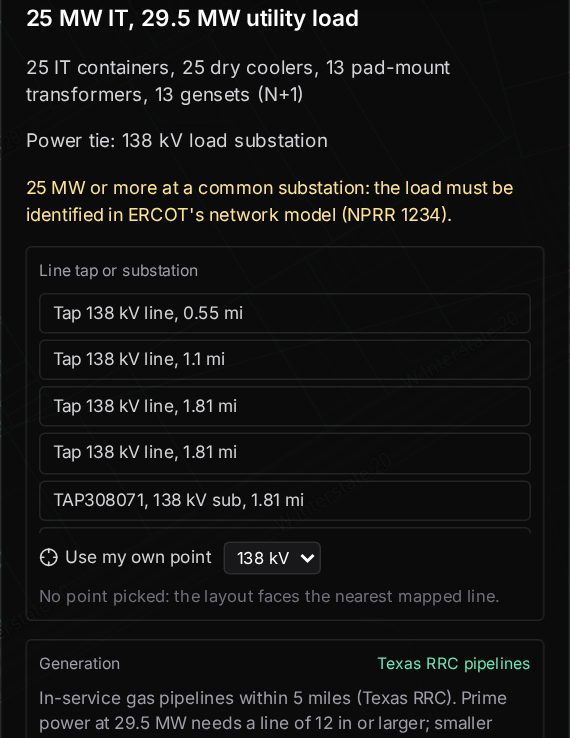
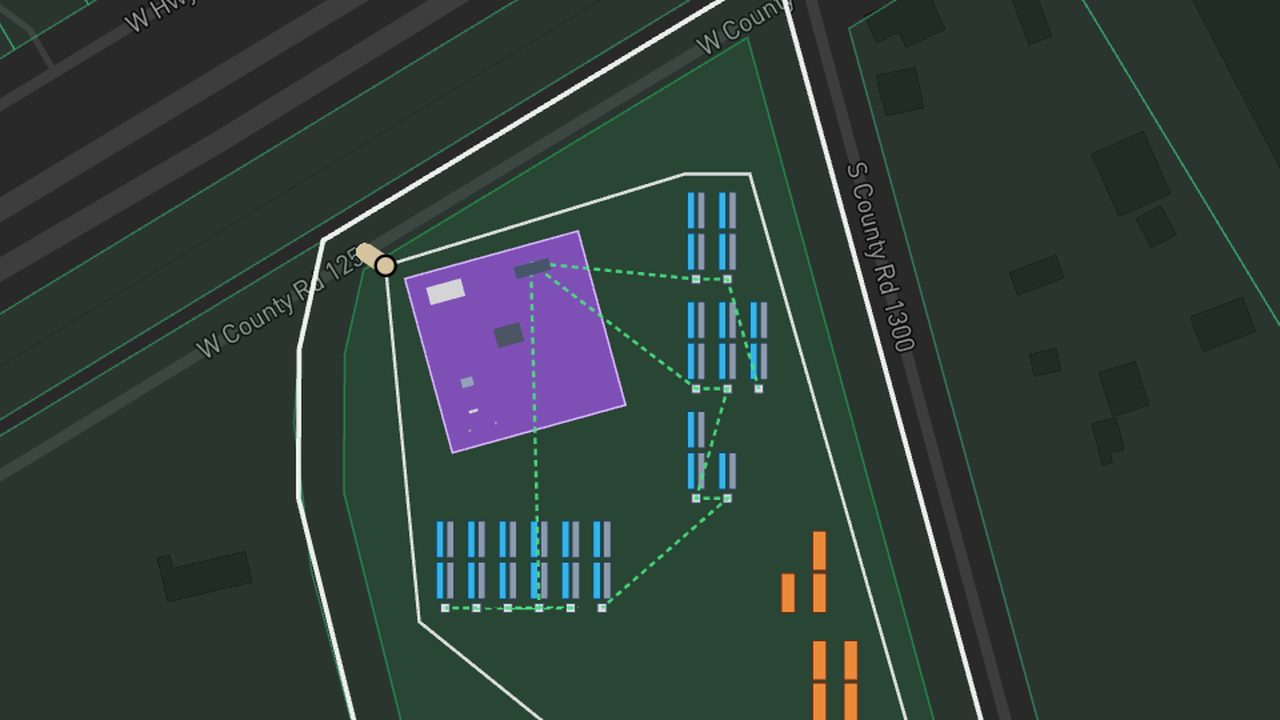
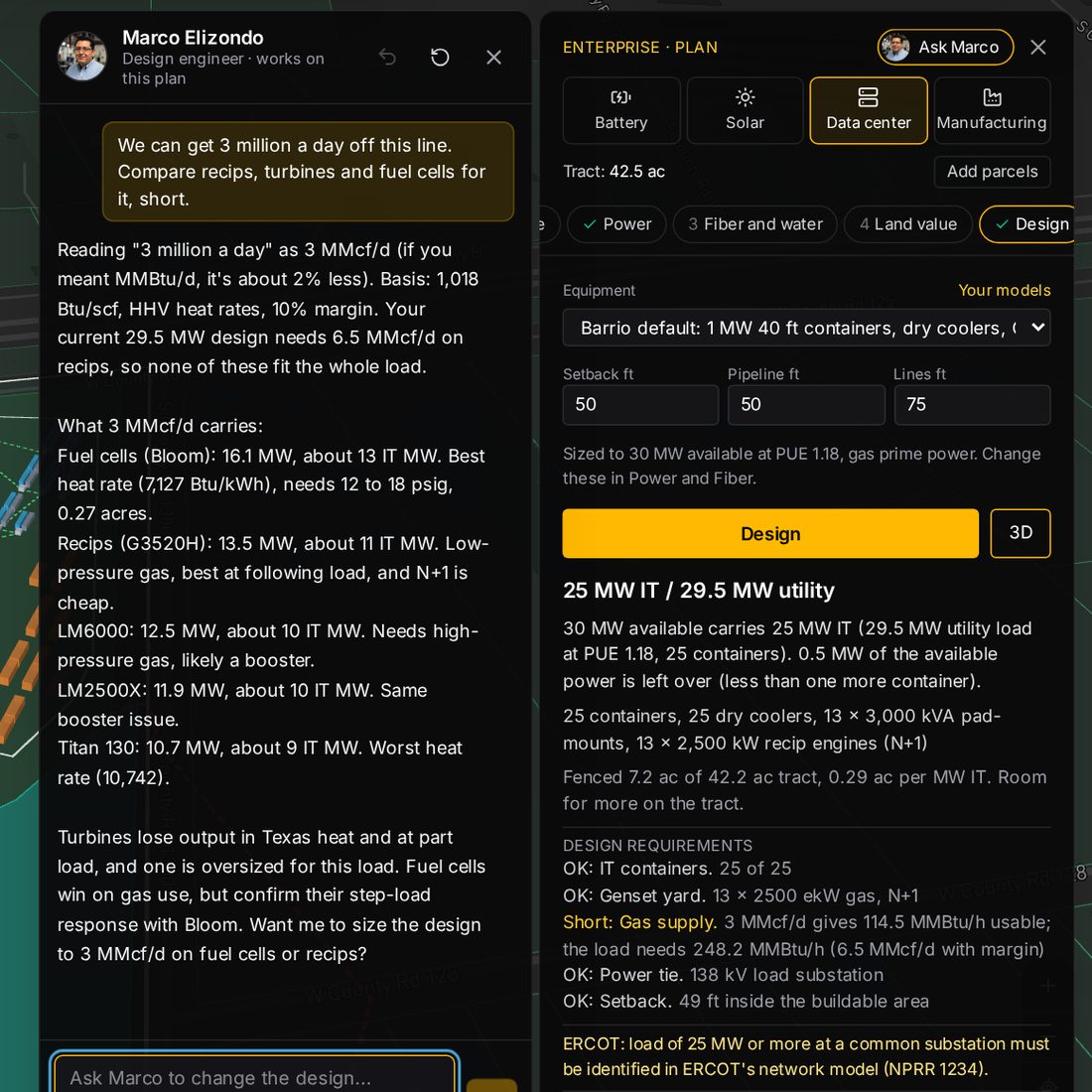
Change the design by talking to Marco
Marco Elizondo is the design engineer in the Plan panel, available on Enterprise. He changes the design by conversation, runs it, and explains what moved. He spent five years inside ERCOT in grid operations and transmission planning, so he reads the interconnection side too.
- Resize this site for 3 MMcf/d of gas and show what it carries.
- What changes if I swap recip engines for fuel cells?
- Size this tract from 30 MW available and tell me the tie.
Data center power questions
How do I convert MMcf/d to MW?
Convert the volume to MMBtu per hour using heat content, take a 10 percent margin, then divide by the genset heat rate. For 3 MMcf/d that is 127.3 MMBtu/h, 114.5 usable, and 13.5 MW carried at 8,465 Btu/kWh HHV. Barrio uses EIA Texas heat content of 1,018 Btu/scf (2024).
Is 3 MMcf/d enough for a data center?
It carries 13.5 MW, which is 11 MW of IT load on recip engines. A 20 MW IT load needs 5.22 MMcf/d with margin, or 199.1 MMBtu/h. Check that the pipeline can deliver the hourly volume, not just the daily one.
Turbines vs recips vs fuel cells for a data center?
On 3 MMcf/d, recips support 11 MW IT, the Solar Titan 130 supports 9, the GE LM2500XPRESS and LM6000PF+ each support 10, and Bloom fuel cells support 13. Fuel cells have the lowest heat rate at 7,127 Btu/kWh HHV, and recips need only low pressure gas. Aeroderivatives often need a booster compressor.
What if there is no gas line nearby?
If the line is smaller than 8 in, or smaller than 12 in above 20 MW utility load, the site runs on the grid with diesel backup. A 9.4 MW load for 48 hours uses about 31,800 gallons at full load on a Cat 3516C (175.3 gal/hr). EPA NSPS Subpart IIII limits emergency engines to 100 hours a year of maintenance and readiness runs.
How do I size a data center from the power available?
Enter the MW available and the plan returns IT load, utility load and tie. On a 42 acre tract, 10 MW available gives 8 MW IT on one distribution feeder, and 30 MW gives 25 MW IT on a 138 kV load substation. At 100 MW available the tract gives 62 MW IT, with a phase 1 cap of 74 MW at 138 kV.
What does the ERCOT 75 MW large load flag mean here?
The Power step flags the ERCOT 25 MW and 75 MW large load levels for your sized load and shows county large-load evidence. Use it to see early whether the project will draw large load attention. Confirm the process and timing with ERCOT and the transmission provider.
Open the map and screen a tract
The map and Dub, the AI landman, are free, and Plan design with Marco and costs are on Enterprise.